
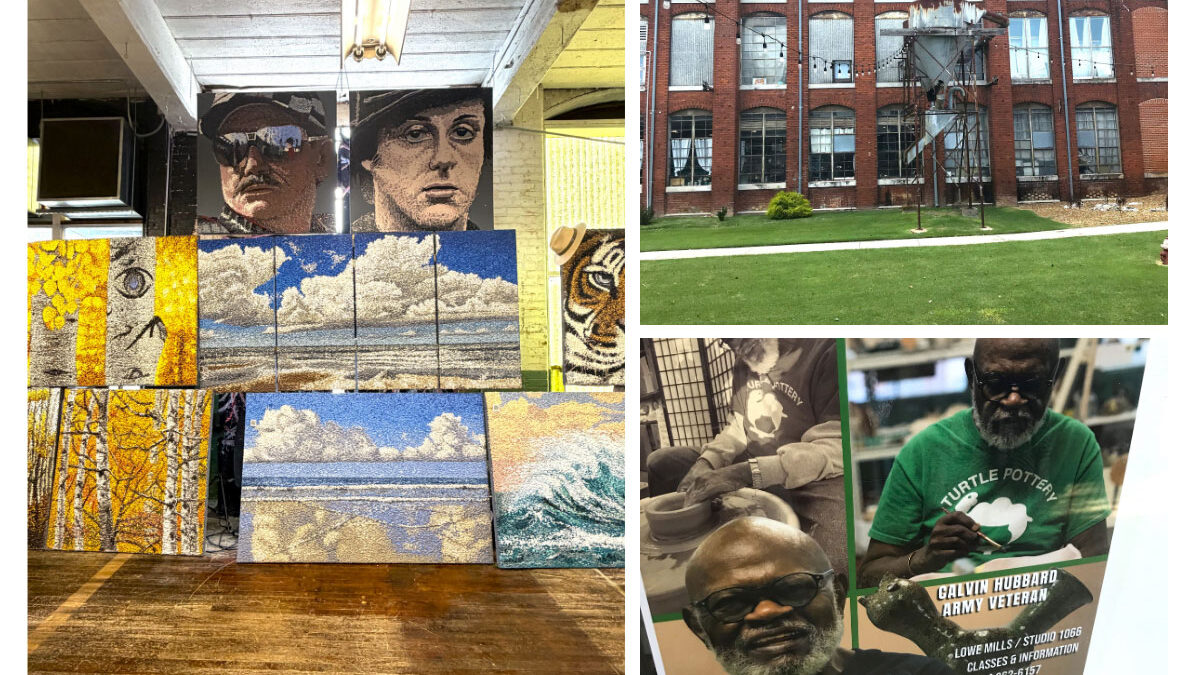
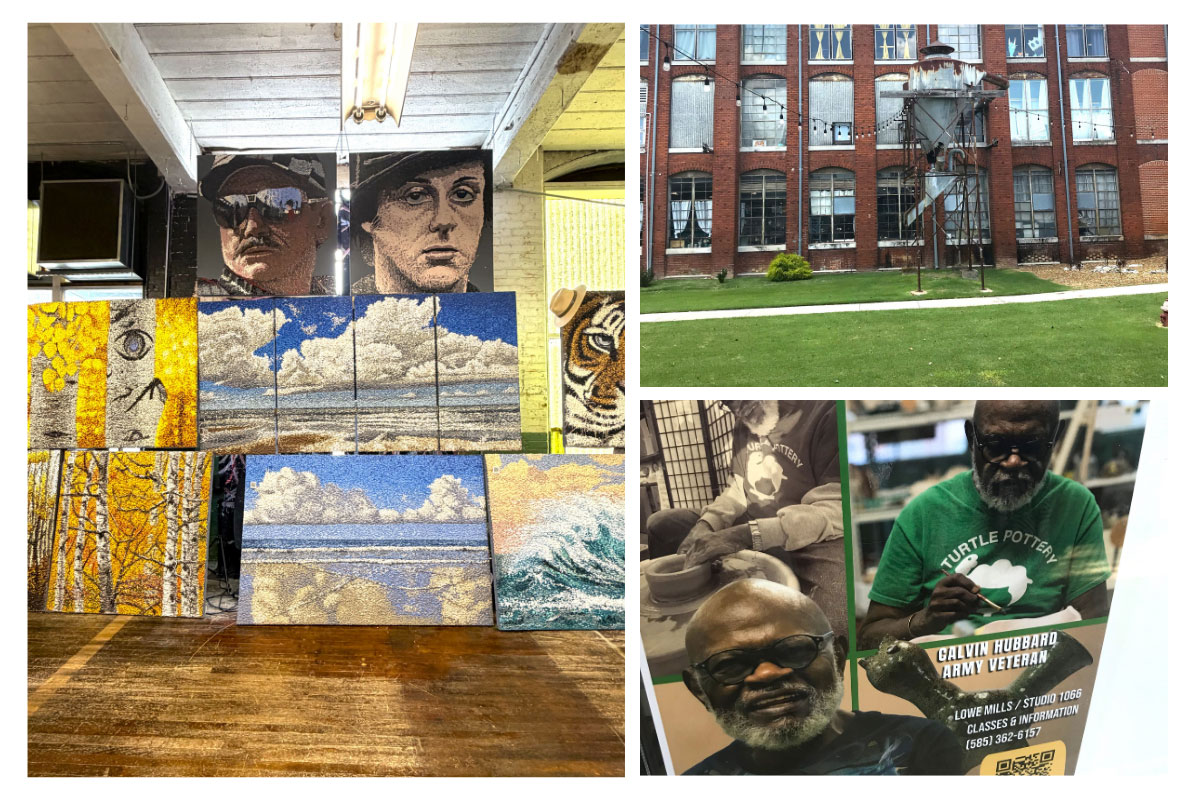
According to the Lowe Mill ARTS & Entertainment website: In 2001, Jim Hudson, founder of HudsonAlpha and Research Genetics, purchased Lowe Mill in Huntsville. Hudson’s dream was an arts center where photographers, sculptors, painters, and potters could live and work. Today, the former textile mill includes shops, music, a dance studio, a culinary school, and space for quirky exhibits. Hudson worked with Huntsville’s artists and creative communities to build a space where the public could interact with visual artists. Today, 200+ creators inhabit Lowe Mill.
A couple of hundred people a month stroll through artist Mike Williams’ Lowe Mill studio. I ask him what makes his art different from others. “The way I do it,” he replies. “My daughter did what is called pour painting. You take different colored paint, pour it in a cup, then pour it on the canvas. When COVID hit, I had a screen-printing business. I was doing a thousand shirts a day.” But COVID took Mike’s production to zero. As he studied his daughter’s paintings, he thought they “didn’t look like anything.” He wondered if he could pour paint out of a cup or bottle and control it enough to make it look like something. A portrait of Elvis proves he could.
I gaze at his large Elvis painting. Amazing! It consists of millions of strategic drops of paint that, from a distance, perfectly capture the image of Elvis Presley. Similar works hang nearby.


Mike puts an additive in the paint to make it thicker, prevent it from running, and help it dry quicker. His experimentation evolved into what has become a unique technique that captures not only images of people, but waterfalls, animals, or whatever.
Earlier, I watched him through his studio window, squeezing paint from a bag. But I didn’t understand what I was seeing. Now, standing in his studio, looking around, I see results—stunning works the likes of which I have never seen.
Other visitors are equally taken by them. A couple from Colorado attending a concert in Huntsville dropped by his studio to buy a $3000 painting of Willie Nelson. Mike sometimes personalizes his art by putting a loved one in the painting, or an object, color, or animal that reminds the buyer of something or someone special. See more at: mikewilliamsfineart.com.
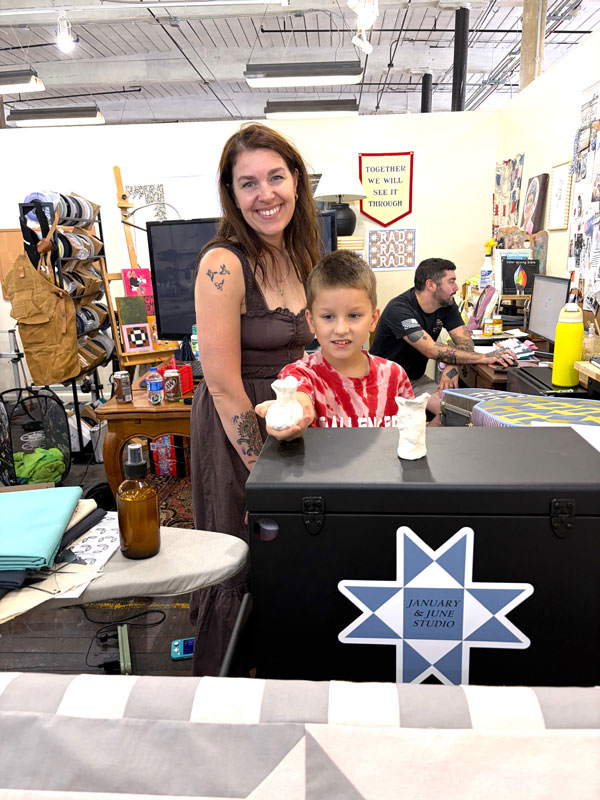
Around the corner, we discover a whole family making a living together at Lowe Mill. Emily Robison, her husband Brad, and their three children are actively creating when we stroll into their studio. Brad designs and produces custom 3D-printed objects. Emily is a fine artist and quilter. Their son, Clive, shows us one of his creations, too. “Brad’s a (U.S.) Marine veteran. We were working out of our home for a long time,” Emily says. She was a stay-at-home mom who now cherishes having her kids close by and involved in the family business. She loves the atmosphere at Lowe Mill—it’s like a family to her.


As evidenced by several examples I’m looking at, she’s an accomplished portrait artist who does a brisk business in commissioned work. I’d characterize her portraits as impressionist. See: emilyrobisonfineart.com.
On the 1st floor, we visit the ceramics studio of Evelyn and Calvin Hubbard. While Cindy and Evelyn talk, I get acquainted with Calvin, who got started with pottery at 19. Still going strong at 86, he learned at the spinning wheel of Carol Sims, and later at Texas Southern University under the famous artist John Biggers, also a sculptor. Calvin worked in Houston until recruited to Rochester, New York. “I spent 27 years in art—(grades) 7 through 12,” he says. After earning his master’s, Calvin got into making sculpture on a potter’s wheel. “Some of the things you see in here are actually made on a potter’s wheel. Some are made by hand, some on a slab,” Calvin says. When I ask how they manage working in the heat of their studio, Calvin replies that he paid his way through college cutting yards in Dallas noontime sun. Also, he served with the 9th Infantry Division in Vietnam. He was there during the 1968 “Tet Offensive” when the enemy blew up an ammunition dump at Long Binh. “I was close enough to see and hear the explosion,” Calvin says. A little heat doesn’t bother him, who, it turns out, is every bit as interesting as his pottery. Amazingly, the boots Calvin Hubbard wore in Vietnam were made at Lowe Mill! See more at: calvinhubbardceramics.com.
Some of the “art” vendors are downright weird, even occultist, as in witches; or spaces wherein someone is sprawled out, as if dead, being tattooed. But Lowe Mill is still a gem of an architectural artifact that is—in and of itself—worth seeing. It’s different. Most of these historic factory buildings were demolished long ago. Few such structures remain, even fewer you may walk around in.
Lowe Mill restaurants look pretty enticing, especially a Texas-style barbecue joint. Be sure to stop by Xavier Akins’ window for a slice of pizza and a cold drink for only five bucks. Xavier’s goal is to be an “executive chef” someday. Working at Lowe Mill helping his dad is his way of furthering that goal. “Lowe Mill by itself is, like, a really interesting place. There’s no other place like it around the U.S. It’s really unique,” he says. I couldn’t agree more.


Cindy and I are glad we decided to check out this one-of-a-kind venue. For a super-interesting history of Lowe Mill, visit: https://lowemill.art/history/.

Jeff Barganier is a novelist, travel writer and speaker. He travels far and wide upon the slightest excuse for something interesting to write about. His novels include Lawson’s Bluff (2021); The Slash Brokers (1998). He also manages Cindy Barganier Interiors LLC at The Waters in Pike Road, Alabama. Contact Jeff at Jeffbarganier@knology.net. You may print out his features at www.jeffbarganier.com and take them with you when you travel!