
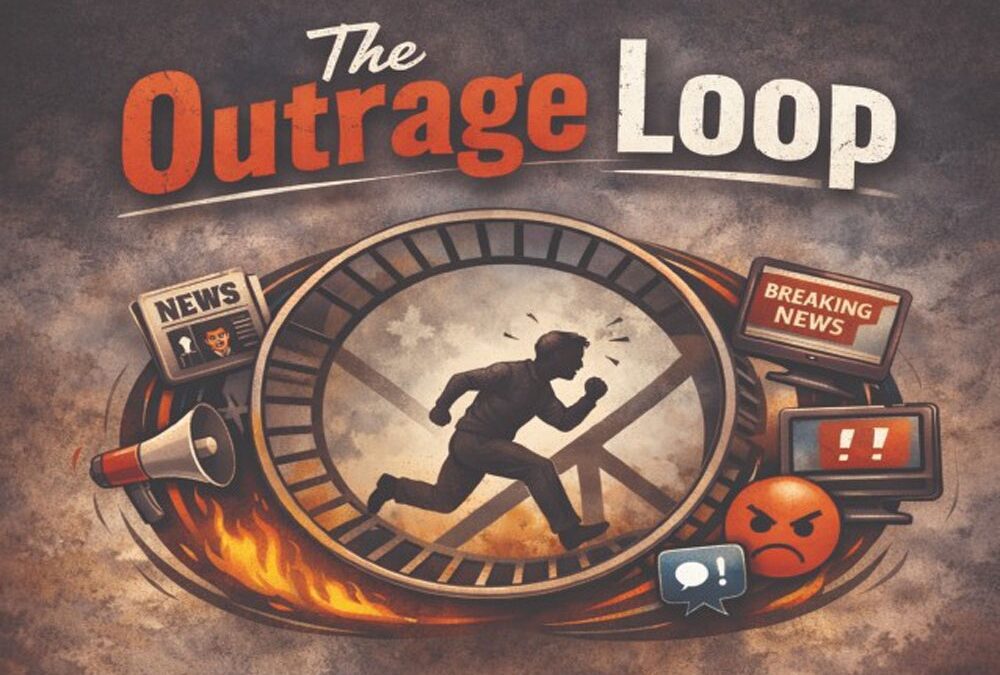
There was a time when the news occupied a defined place in our day.
We unfolded the morning paper at the kitchen table. We watched the evening broadcast.
We absorbed what had happened, maybe disagreed with an opinion column, and then moved on to dinner, family, church, work, neighbors. Being informed did not require being emotionally activated. You could care deeply about the world and still feel settled inside it. Many in the 50+ generation remember that rhythm.
Somewhere along the way, the rhythm changed.
Today, information rarely just informs. It competes. It provokes. It insists. It follows us from television to phone to tablet to social feed. It is no longer confined to a morning paper or a nightly broadcast. It is ambient — always present, always available, always ready to stir. And the primary fuel keeping it alive is outrage.
This isn’t about political affiliation. It isn’t about which network or which side. It’s about mental health, human design, and the quiet ways our daily lives are being shaped by systems that benefit when we stay emotionally activated.
When Information Became Immersion
Modern media operates inside what’s called the attention economy. Attention equals revenue. The longer we stay engaged, the more valuable we become. Calm doesn’t hold attention particularly well. Nuance doesn’t spread quickly. Anger does.
So headlines sharpen. Language intensifies. Stories are framed not merely as events, but as existential threats.
There is always urgency. There is always a villain. There is always something at stake that demands our emotional participation.
It is important to say clearly: this dynamic is structural. It is not confined to one ideology. Outrage performs well across the spectrum. It generates clicks, shares, subscriptions, ratings. It keeps us returning.
Over time, something subtle but powerful happens. Awareness turns into repetition. Repetition turns into fixation. Fixation turns into habit. We no longer consume information. We live inside it.
The Psychology of the Loop


Counselors use a word for repetitive, unresolved thought patterns: rumination.Rumination occurs when the mind circles the same concerns again and again without moving toward resolution. In personal life, it often shows up as anxiety. It is one of the most common reasons people seek counseling. When someone says, “I can’t stop thinking about this,” what they are often describing is a loop.
Healthy cognition has exits. We encounter a problem and either take action or release it. We fix what is within reach. We entrust what is not. The nervous system calms when it receives the signal that something has been addressed or safely set down.
But what happens when the stimulus never stops?
The modern news environment has perfected a version of rumination on a societal scale. The same themes repeat daily. Emotional intensity remains high. Our individual ability to influence those themes remains limited.
There is rarely an off-ramp.
The brain never hears, “You’ve done what you can.” Instead, it hears, “Stay alert.” “Anger is meant to move us toward action. When it has nowhere to go, it turns into agitation.”
Imagine sitting in a counseling office and saying, “I think about these problems every day. I feel angrier the more I think about them. I can’t do much to change them, but I keep consuming information that keeps me upset.”
A thoughtful counselor would not encourage you to increase your exposure. They would gently explore boundaries, agency, and where your energy can be used constructively.
Yet when this same pattern shows up around public issues, we often rebrand it as responsibility. We tell ourselves we are staying informed. We tell ourselves caring requires constant immersion. But patterns that drive people to counseling do not become healthy simply because they involve national headlines.
The Missing Word: Agency
At the center of this conversation is a word we rarely use: agency. Agency is your real ability to take meaningful action. When information increases agency, it clarifies where you can respond. It points toward local engagement, personal responsibility, or concrete steps. It helps you move.
When information decreases agency, it raises emotional temperature while lowering practical influence. You feel invested but immobilized. Engaged but powerless.
Over time, that combination has consequences. Anger without agency does not strengthen character. It narrows it. It tightens posture. It shortens patience. It subtly trains us to scan for threat rather than possibility.
Many of us have noticed something in ourselves over the past decade. We are quicker to react. Quicker to categorize. Quicker to assume we know where someone stands before hearing their whole story.
This is not simply political polarization. It is what happens when the nervous system lives in sustained activation.
The Results Test
Instead of debating media motives or arguing about bias, there is a simpler evaluation available to us. Look at the results. Are we becoming more patient? More curious? More generous in how we interpret others? Or are we becoming more brittle? More dismissive? More inclined to speak in shorthand about entire groups of people?


Do we still see neighbors — or do we see categories? Do we still enjoy everyday life — or does a low-grade hum of irritation follow us into dinner conversations and family gatherings?
Many in the second half of life carry a growing sense that something feels off. Not necessarily in what we believe, but in how we feel.
Conversations feel tighter. Grace feels scarcer. It is easier to reduce someone to a headline than to remember they are a complex human being with history, family, fears, and hopes.
“Outrage doesn’t expand our lives. It contracts them.”
It shrinks conversations. It narrows circles. It reduces curiosity. It makes disagreement feel dangerous instead of normal. And over time, it makes our world smaller.
Technology and the Amplification Effect
None of this is accidental. Algorithms are designed to maximize engagement, not peace of mind. If anger keeps you watching, anger will be delivered. If fear keeps you scrolling, fear will rise in your feed. Over time, the system learns what provokes you specifically and feeds it back with increasing precision.
What begins as curiosity becomes habit. What begins as concern becomes identity. We begin to consume not simply to understand but to belong — to feel aligned with a group that shares our interpretation of events. Shared outrage becomes a bonding mechanism.
There is comfort in alignment. There is reassurance in hearing our frustrations echoed. But if the cost of belonging is constant agitation, it is worth asking whether the trade is wise.
A Generational Advantage
Those over 50 possess something invaluable in this moment: perspective. You have lived through multiple media eras. You remember when newspapers dominated, when cable news emerged, when the internet arrived, when social media reshaped discourse. You have watched the volume rise.
That memory is not nostalgia. It is data. You know what it felt like to be informed without being engulfed. You know that it is possible to care deeply about public life and still maintain emotional steadiness.
This generation is uniquely positioned to model something younger generations desperately need to see: strength without constant anger, conviction without perpetual agitation, engagement without obsession.
Choosing a Different Posture
Stepping out of the outrage loop does not mean stepping out of the world. It does not mean apathy. It does not mean indifference. It means refusing to live in a constant state of unresolved alarm.


A healthier posture might look quieter and more deliberate. It might involve setting boundaries around media exposure. It might mean choosing a few trusted sources instead of endless commentary. It might involve investing more time in local relationships than national debates.
It certainly involves asking one honest question: Is this input helping me live the kind of life I claim to value? If the answer is no, adjustment is not weakness. It is wisdom.
“Being informed does not require being inflamed.”
We can learn what matters. We can act where we have influence — in family, church, neighborhood, local community. We can vote, volunteer, advocate when appropriate. And then we can return to the tangible world around us. We can choose to invest in conversations that enlarge rather than shrink. We can practice seeing the whole person rather than the political label. We can allow disagreement without assuming hostility.
These are not small things. They are cultural acts.
A Larger Life
In the second half of life, priorities clarify. We care about legacy. About how we are remembered. About whether we were steady or reactive, generous or suspicious, grounded or perpetually unsettled.
A larger life is marked by perspective. It is marked by relationships that outlast headlines. It is marked by joy that survives news cycles.
The most radical act available to many of us right now may be surprisingly simple: step out of the loop and live well anyway. Not in denial. Not in ignorance. But in measured engagement.
Sometimes the strongest posture is steady presence. And sometimes the healthiest response to a system that profits from our agitation is to quietly, deliberately reclaim our attention — and use it to build something better close to home. •