

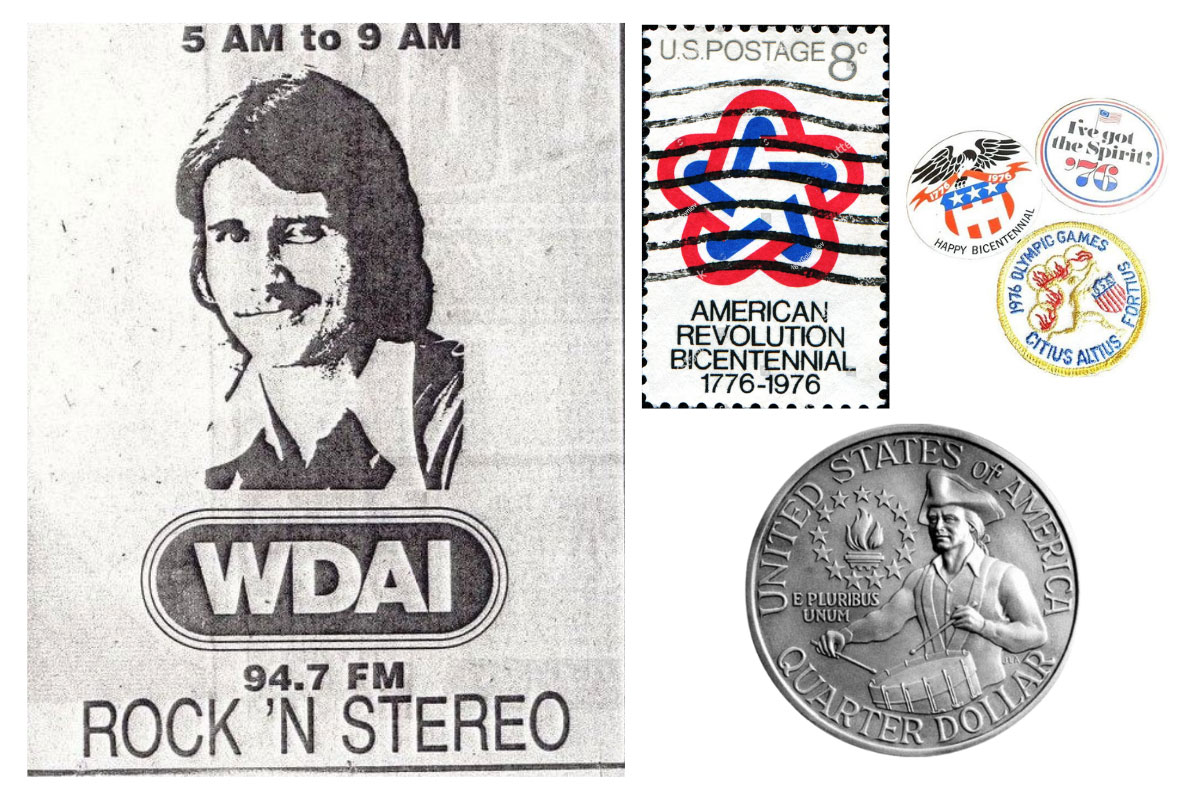
I recently asked Siri to give me the word for “250th Anniversary”. For the first time, I heard her say, “I don’t know!” Quarter-millenia? We have a year to figure it out. We all remember the Bi-centennial.
In 1976, America threw itself a 200th birthday party so gaudy, patriotic, and gloriously over-the-top that it’s still seared into the memory like a sparkler burn on a picnic table. We celebrated it. We wore it. The Bicentennial wasn’t just a historical milestone; it was a cultural juggernaut that swept up everyone from disco dancers to suburban moms, uniting the nation in a fever dream of red, white, and blue. Let’s look back at the star-spangled extravaganza and its lasting, sometimes cringe-worthy, impacts.
Like Bi-centennial jeans? Shoes? Shirts. Red, white, and blue trim on houses. I saw it! I had a pair of the jeans, too.
The buildup to July 4, 1976, was like watching a nation chug a gallon of patriotic Kool-Aid. For years, the American Revolution Bicentennial Administration (yes, that was a real thing) orchestrated a campaign to make sure no American could escape the festivities. Cities, towns, and even the tiniest hamlets were decked out in bunting, flags, and enough eagle imagery to make a bald eagle blush. The official logo—a star wrapped in a ribbon of red, white, and blue—was slapped on everything: T-shirts, mugs, keychains, even toilet paper for the truly devoted. Consumerism and patriotism had never been so gloriously intertwined. Why buy a plain toaster when you could get one emblazoned with “1776-1976”?
The cultural impact was immediate and relentless. Fashion took a hard turn into Revolutionary chic. Men sported tricorn hats unironically, while women donned colonial-style dresses that screamed “Martha Washington, but make it polyester.” Kids weren’t spared either—Bicentennial-themed lunchboxes featuring minutemen and Liberty Bells were the must-have playground accessory. Even pets got in on the action, with dog collars and cat beds festooned with stars and stripes. The nation was drowning in kitsch, and it loved every second of it.

Our family’s wiener dog wore a red, white, and blue tube sweater!
Music, too, caught the Bicentennial bug. While disco ruled the airwaves, patriotic anthems sneaked into the mix. Johnny Cash, ever the American icon, released albums dripping with frontier spirit, and school choirs belted out “Sweet Land of Liberty” and “Nifty 50” with the fervor of tiny revolutionaries. Meanwhile, advertisers leaned hard into the theme. McDonald’s rolled out Bicentennial glasses featuring George Washington and Ben Franklin because nothing says “freedom” like a Big Mac and a collectible tumbler. Jingles about liberty and unity blared from every TV and radio, embedding themselves in brains alongside ABBA’s “Dancing Queen.”
The main event, of course, was July 4 itself. Across the country, communities went all out. Parades featured floats shaped like the Liberty Bell, reenactors in wool uniforms sweating through musket drills, and kids waving sparklers like they were conducting a patriotic orchestra.
In Washington, D.C., the festivities were next-level. Operation Sail brought tall ships from around the world to New York Harbor, a majestic nod to America’s seafaring past. Fireworks lit up the sky in displays so extravagant they made modern Fourths look like backyard bottle rockets. President Gerald Ford, not exactly a charisma machine, gave speeches that tried to rally a nation still licking its wounds from Vietnam and Watergate. For one day, at least, the country seemed to agree: America was pretty darn cool.
But the Bicentennial wasn’t just a one-day blowout; it left a cultural footprint that’s still visible if you squint. For one, it sparked a renewed interest in American history. Museums saw record visitors, and historical societies flourished as people dug into their roots. Shows like Roots, which aired in 1977, owed part of their success to the Bicentennial’s push to explore the American story—warts and all. Genealogy became a national pastime, with families tracing their lineage back to Revolutionary soldiers or, in some cases, just making it up for clout at the local VFW.


It also cemented the Fourth of July as America’s ultimate party day. Before ’76, Independence Day was big, but not this big. The Bicentennial turned it into a cultural juggernaut, complete with branded merchandise and over-the-top displays of national pride. Today’s backyard BBQs, flag-themed bikinis, and monster-truck-sized fireworks owe a debt to that summer when America went all in on itself.
Yet, not everything about the Bicentennial aged well. The unrelenting patriotism could feel forced, especially for those grappling with America’s less rosy realities—no county is historically wartless. Some critics called it a distraction, a way to paper over division with flags and fanfare. And let’s be honest: the sheer volume of tacky souvenirs was a crime against taste.
Those Bicentennial plates gathering dust in thrift stores? They’re the ghosts of ’76, haunting us with their earnest excess.
In the end, the Bicentennial was America at its most gloriously absurd—a nation that could celebrate its past while disco-dancing into an uncertain future. It was a moment of unity, however fleeting, in a decade of fracture and malaise. Its cultural impacts linger in our love of spectacle, our obsession with history (real or mythologized), and our unshakeable belief that everything’s better with a flag on it (because it is!).
So here’s to 1976: the year America threw a party so big that we’re still finding confetti in our cultural couch cushions.

And here’s to 2026! With President Trump, the celebration could make ’76 look like a kid’s birthday party. I hope it does. When you think about it, BOOMers are lucky to have a shot at two huge national birthday parties.
Or, as the Founders called it- the Original No Kings Day.
Greg Budell has lived in Montgomery for 20 years. A 50+ year veteran of radio, TV and writing, Greg hosts the Newstalk 93.1FM Morning Show with Rich Thomas, Susan Woody, and Jay Scott, 6-9 AM Monday – Friday. He returns weekday afternoons from 3-6 PM for Happy Hour with Pamela Dubuque and a variety of sidekicks. His favorite topic is life! Greg can be reached at gregbudell@aol.com.