
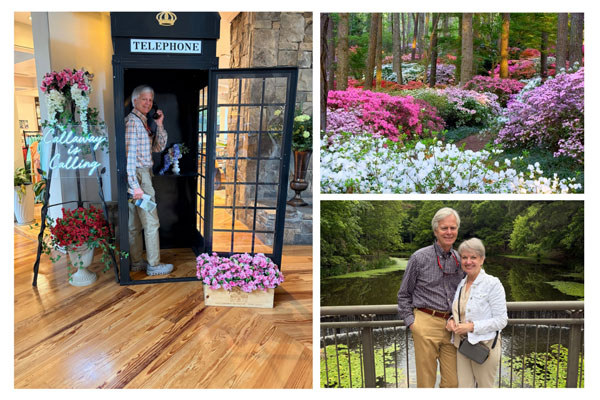
The story of Callaway Gardens is reminiscent of Bible prophecy. Isaiah 35:1 NIV: The desert and the parched land will be glad; the wilderness will rejoice and blossom. According to horticulturist Chris Hall, “Mr. (Cason) Callaway was into conservation. This property was burnt-out cotton and corn production land. He bought it and started immediately trying to rebuild the soil and plant native plants. The garden itself is 2,500 acres. But there are 1,700 acres of native plants.”

Serenaded by an aerator splashing water into a pond below us, we stood on a terraced hill and listened as Chris discussed Callaway’s interesting history and the many facets of managing the gardens. “I got into the horticulture department and started learning as much as I could. I’ve enjoyed learning from past employees, like Patricia Collins. She knows absolutely everything. Patricia was our director of education, here from the very beginning, and knew a lot. I never liked public speaking. But she said, ‘You’re gonna do it. I’m giving you an azalea talk, and you’re gonna do it.’ I appreciate Patrica for pushing me into this and making me learn more.
“Callaway opened in 1952. But construction started in the late forties. The azalea gardens were not here in ‘52. It was mainly an outdoor getaway for people from Atlanta. What’s original is a horseshoe-shaped pavilion that’s been here since ‘52. It originally housed a daycare. Families from Atlanta would come. The parents could go out into the gardens and partake in walking on natural trails. The infants—and I’ve seen old pictures—had cribs everywhere in there. They had nannies dressed up in nurse-type uniforms. The pavilion hearkens back to those old days.
“Now, Overlook Garden did not get here until 1971. These oak trees you see around here are white oaks. Mrs. Callaway collected all of the acorns, and when they still lived in LaGrange, she grew them at her house from acorns. When the Callaways moved to Blue Springs over here in Hamilton, she brought them with her and planted them at Blue Springs.



Then, when they bought this property and started to develop it in the fifties, she had someone dig up those oak trees and plant them here. All these oak trees in the median and both sides of the parking lot have been here since 1952. Mrs. Callaway loved to garden and the quintessential Southern magnolia. She loved the trees and the flowers. She wanted a magnolia tree for her birthday one year, so Cason, who didn’t do anything on a small scale, bought her one large ball burlap magnolia tree and between 3000 and 4000 one-gallon magnolias that she could plant out and about. We have on the property between Blue Springs and here thousands of magnolias. That was Mrs. Callaway’s tree.
“They built the gardens. People started coming. Mr. Callaway wanted to expand it, to bring more people in. In 1971, he started building the original azalea gardens. This azalea garden is about 36 acres. There are roughly four thousand hybridized azaleas in (Overlook Garden). Scattered throughout the gardens are about 1000 to 1200 native azaleas. They collected azaleas from all over. They took cuttings and built a nursery to house them before they could even build the gardens. (The nursery) was built in the late sixties just to house these plants for this garden.
“The Callaway Brothers Azalea Bowl was in 1999. All those azaleas came from cuttings from this garden. There are two design philosophies between these two gardens. In the seventies, they just randomly planted azaleas out into this (Overlook) Garden. It’s like a kaleidoscope of color. But when they built the Callaway Brothers Azalea Bowl, they wanted pattern. It was a flow of color. And that’s how the Brothers Azalea Bowl is—whenever you walk down through it, the whites will flow into the light pinks, into the darker pinks, to hot pinks. And it’s really pretty. But the Overlook Garden is also beautiful because of its different colors.
“There are very old azaleas in this garden. Some are getting to the end of life, growing since 1952. Down by the lake, they are absolutely huge—twelve feet tall. We treat the Overlook Garden differently than we do the Brothers Garden. Over here, we do not rejuvenate azaleas.


We let them grow. These are the originals, so we let them get big as they want. But in the Callaway Brothers Azalea Bowl, we prune them, keep them nice and tidy. Whenever they get too big, we do a rejuvenation cutting to allow them to regrow, to keep them on the smaller size.
“We have tons of deer. They don’t really touch the azaleas. We plant so many bedding plants around here that they eat our flower beds,” Chris said. The biggest problem Chris has is armadillos and deer destroying plants set out at the Butterfly Center. The deer paw the ground and dig up tulip bulbs. Armadillos plow the ground like tillers. One time, the deer set off the water sprinkler and flooded the bed, destroying it. Chris said they have every kind of critter except feral hogs … so far. But practically every day he has to repair deer and armadillo damage and replant.
“There was a dead tree off the trail. About eighteen feet up was a big hole. Whenever I would find a bat, I’d take it up a ladder and put it in that hole. Then one year, I looked up at the hole. A little biddy raccoon was looking back at me. I took some pictures of it lying up there, his head kind of hanging out the hole, looking at the day. He’d made it his home. It was adorable. We also have a family of foxes. I saw a mother crossing the road, four little kits behind her. They were just crawling all over each other, playing, starting their day, mother getting out, having fun. And this morning, I saw a little kit on that side of the garden, and he was just playing—so beautiful.”



Callaway’s gracious staff creates a pleasant and inviting atmosphere. They demonstrate a love for guests and for one another. It’s Callaway Resort & Gardens’ legacy and the charm that keeps people returning for generations, when they remember and hear Callaway calling.
Photos Provided by CG


Jeff Barganier is a novelist, travel writer and speaker. He travels far and wide upon the slightest excuse for something interesting to write about. His novels include Lawson’s Bluff (2021); The Slash Brokers (1998). He also manages Cindy Barganier Interiors LLC at The Waters in Pike Road, Alabama. Contact Jeff at Jeffbarganier@knology.net. You may print out his features at www.jeffbarganier.com and take them with you when you travel!