
A few years ago, a talented young Mobile entrepreneur named Brad May purchased my memoir, “How Prayer Helped Me Escape the Corporate Rat Race.” He later contacted me via email to convey his thoughts about my book. His exact words were: “I put it above the stacks of other books I had lined up to read. I usually focus on one book at a time to complete, but I actually put down the current book I was reading to read yours. It took me a long time to complete (months of reading little bits here and there), but now that I’ve finished it, this has been one of the most impactful books I’ve ever read. As I got into many of the stories of your life you put in the book, in the back of my mind, I was asking, ‘ok, but where’s the stuff about prayer?… where am I going to see what formula Jeff used so I can do it too?’ I actually made comments to my wife in disbelief about why the book seemed so slow and disconnected.
I KNEW God had led me to buy that book and put it on the top of my list. I just couldn’t reconcile what I was reading. It was interesting in its own way, but not what I expected. Then I got to the chapter, ‘On Changing Course.’ I was in tears reading this. I felt God’s presence when I got to this part of the book. I’m supposed to be outside doing yardwork today, but I couldn’t put the book down after I read the opening line of that chapter. It stated what I had been thinking:
You may be thinking that my focus has been less about prayer than about the mundane ventures of life. But praying, in and of itself, doesn’t mean that the challenges of life are rendered null and void. …We must still make decisions, contemplate the world around us, and fulfill obligations both great and small. Prayer, however, changes how we make those decisions, how we contemplate the world and how we meet our obligations.


“I have been reminded that there’s no secret path or tactical formula to employ to get where God is leading me. I think if you had asked me, I would have said that I knew that intellectually…but I had to admit I came into this book expecting one thing and got another. A perfect example of life sometimes. Reading this book was more of an experience than an information-gathering exercise. Had I not completed the book, I wouldn’t have gained this insight, which is exactly one of the things your book has taught me: keep moving forward in faith in what God has led you to do next, even when it seems mundane.”
Although we had never formally met, I ended up hiring Brad’s firm, Genesis Bay (www.genesisbay.com), to manage my website, www.jeffbarganier.com. As Brad’s communication about my memoir was by far the most meaningful review of that particular book that I had received, I wanted to make his acquaintance. So, as an excuse for getting to meet Brad in person, I decided to visit the History Museum of Mobile.
Museums are remarkable places to learn how humanity keeps moving forward. Unlike libraries, museums offer the opportunity to see and sometimes feel actual objects of antiquity. Whereas, books merely allow us to read about things. But before modern printing presses generated books to fill libraries, what did books and documents look like? Through May 25, 2025, you can go see for yourself at the History Museum of Mobile. The exhibit is titled, “Painted Pages: Illuminated Manuscripts 13th to 18th Centuries.” When I learned this exhibit included a Hebrew scroll of the biblical Book of Esther, I had to see it with my own eyes.
This exhibition comes from the collection of the Reading Public Museum in Reading, Pennsylvania. It includes examples of materials used to create historic manuscripts—parchment, vellum (animal skin), gold leaf, and minerals that, once ground into powder, yielded pigments used by artists before the age of printing. French, Italian, Spanish, Dutch, Flemish, English, and German examples are included. These diverse and colorful works give insight into medieval European and even Middle Eastern history from the sacred to the secular.


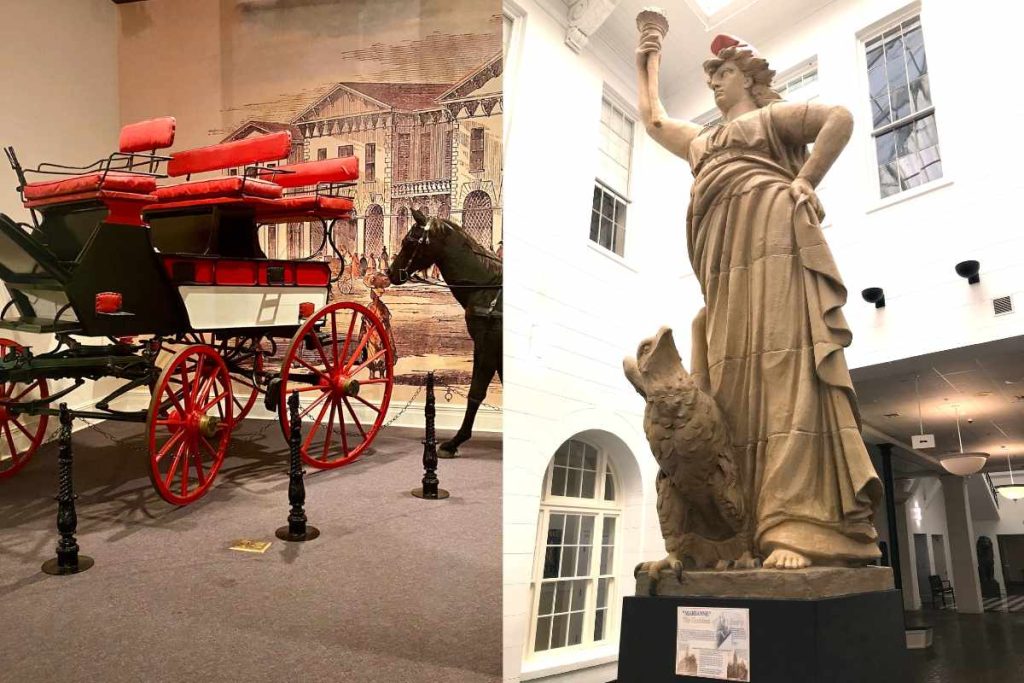
Other museum exhibits include: a collection of horse-drawn carriages; a collection of miniature Mobile architecture; artifacts from frontier days; native-American implements; and much more. The History Museum of Mobile is open Monday through Saturday, 9:00 a.m. to 5:00 p.m. and Sundays, 1:00-5:00 p.m. Tickets for “Seniors” are $12. But we were able to park free right in front of the door.
While in the Mobile area, Cindy and I stayed at the Hampton Inn Fairhope/Mobile Bay, just up the street from Page and Palette Books, where I have conducted book signings.
We also ventured over to Bon Secure Bay and dined at Tin Top. It’s just a few miles from another favorite restaurant—Jesse’s. Laid back Tin Top has great seafood and outstanding management. When Cindy wanted to watch the Auburn/LSU basketball game, the manager, Justice, personally found the station for us and put it on the screen nearest our table. Our waitress, Kimberly, who possesses a bright and charming smile, was the best of the best. And because of nice folks like Justice and Kimberly, we’ll visit Tin Top again … next time we need an excuse to visit Brad.



Meanwhile, in his words, “Keep moving forward in faith …” And so will we. Many blessings.
Jeff Barganier is a novelist, travel writer and speaker. He travels far and wide upon the slightest excuse for something interesting to write about. His novels include Lawson’s Bluff (2021); The Slash Brokers (1998). He also manages Cindy Barganier Interiors LLC (www.cindybarganier.com) at The Waters in Pike Road, Alabama. Contact Jeff at Jeffbarganier@knology.net. You may print out his features at www.jeffbarganier.com and take them with you when you travel!